
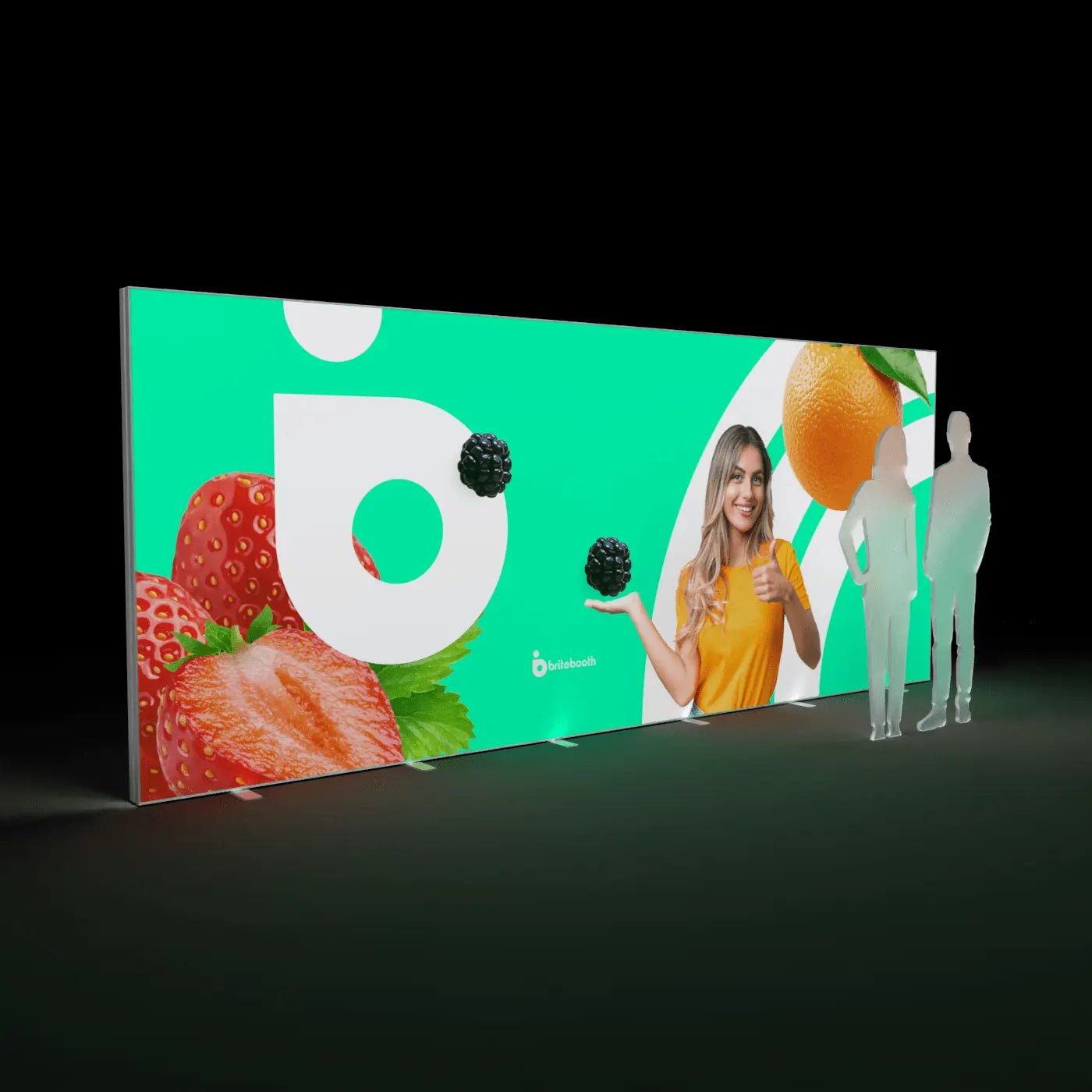
Short answer: Backlit displays cost more upfront — typically $1,000–$4,000+ for a single wall vs. $300–$800 for a comparable non-backlit tension-fabric stand — but deliver meaningfully better visibility and color impact under typical convention-hall lighting. Standard displays make sense on a tight budget or for infrequent, low-stakes use.
The real difference: light source, not just appearance
A standard (non-backlit) display relies entirely on ambient venue lighting, which varies wildly between show floors — some halls are bright and even, others are dim with harsh overhead spotlighting that creates glare and washes out printed colors. A backlit display carries its own light source inside the frame, so it looks the same whether the hall lighting is flattering or not.
Cost comparison
| Backlit (BriteBooth) | Standard tension fabric | |
|---|---|---|
| 8ft wall | ~$1,579 (WaveLight) | ~$300–$500 |
| 10ft wall | ~$1,909 (WaveLight) / ~$2,254 (SEGO) | ~$400–$700 |
| Full 10x20 kit | ~$7,200–$12,000 (Casonara) | ~$1,500–$3,000 |
| Power required | Yes — standard 110V outlet | No |
The gap narrows over multiple events: a backlit frame is reusable for years with only the graphic needing replacement, so the per-show cost drops the more often you exhibit.
Visibility and engagement
Even, internal illumination makes colors read brighter and more saturated from across an aisle, and photographs and shows up better in attendee photos and booth-walkthrough video than a flat-lit panel. This matters most in larger halls where your booth is competing with dozens of others for attention from 20–50 feet away.
Setup and logistics
Both formats are largely tool-free, but backlit displays need a power drop at your booth — confirm this is included in your booth package before you order, since not every show-floor location has electrical as standard. Standard displays have no power dependency, which simplifies logistics for outdoor events or venues with limited electrical access.
When a standard (non-backlit) wall makes more sense
- You're exhibiting once and don't expect to reuse the hardware
- Your venue doesn't guarantee power at your booth location
- Budget is the primary constraint and visibility is a secondary concern (e.g., a low-traffic local event)
- You need something extremely lightweight for frequent air travel with no checked-case option
When backlit is worth the extra cost
- You exhibit multiple times per year, so the frame cost amortizes across shows
- You're in a large hall or island booth competing for attention across a wide aisle
- Brand perception matters — backlit reads as a more established, higher-investment presence
- Your graphics rely on color accuracy or photography that benefits from even illumination
Related reading
Shop collections: FrameBright · WaveLight · Casonara
Share:
RGB vs CMYK for Backlit Fabric Prints
LED Lightbox Lifespan, Brightness, and Maintenance